

Advocacy and Healthy Life Expectancy in Scotland
Updated: Mar 19
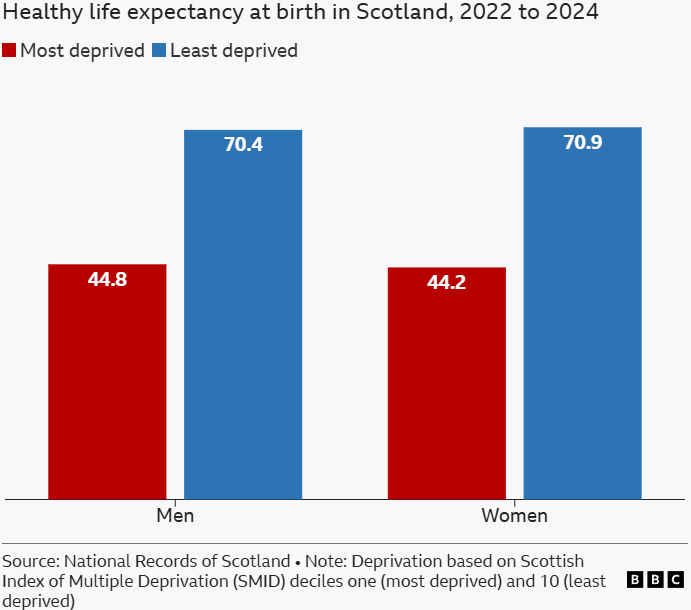
Recent figures on Healthy Life Expectancy from National Records of Scotland contained no surprises for workers on the front line in Scotland but are just another reminder of the social health inequalities around us.
Females born in the period 2022-2024 in Scotland can expect 59.4 years of good health, while males can expect 59.1 years.
With women living longer than men, women are more likely to not be living in good health for a greater proportion of their lives than men are.
Since the start of the time series in 2013-2015, HLE was highest for both sexes in 2014-2016, and has been decreasing since then.
So, while we can expect to live for longer, a greater proportion of life is likely to be spent in poor health now than in previous years.
The difference in HLE between the most and least deprived areas is very wide: 26.7 years for females, and 25.6 years for males.
We have written to NRS asking if figures show an increase or decrease over time in the differences between both types of area. Its too soon for us to have received a response. We'll keep you updated.
Public Health Scotland have published a response to these figures, citing their ten year action plan for impriovement.
We will all have our opinions on the causes that contribute to the drastic differences between what can be expected by those living in the most deprived areas as opposed to those living elsewhere. In our opinion, there is a lack of awareness of Human Rights and how Human Rights legislation underpins the legislation and policies that service providers are supposed to adhere to. This lack of awareness is more likely to result in people living in deprived areas being unaware of how to hold service providers to account.
Accessing appropriate services, be it housing, healthcare or welfare benefits, is becoming increasingly difficult. This difficulty can't fail to have a more significant, negative impact on those living in deprived areas than those living elsewhere. This is where advocacy is most needed - a service that provides assistance in overcoming barriers in accessing essential services.
A trained advocate's knowledge, experience and resilience does make a difference. Feedback from our Advocacy Training programmes - our workshops and SVQ award in Human Rights Based Advocacy - suggests that those who have completed the award find the tools and techniques discussed are effective in helping them carry out this vital role.


